External Author – Madi Johnson
Note that this tutorial is not my own work, but was developed by the excellent Madi Johnson and is hosted here for convenience.
Intro
This section contains general information about the AIAA DBF competition that generally does not change from year to year, as well as a summary of what mission and requirements may look like each year. This analysis is based on 3 years (2021-2023) of finalized rules.
Team Requirements
The AIAA maintains standards for the demographics of each team. Each set of rules in the last three years has included the following statement:
All team members (except for a non-student pilot) must be full time students at an accredited University or College and student members of the AIAA. At least 1/3 of the team members must consist of freshman, sophomores or juniors (below senior year, for non-four year programs). The pilot must be an AMA (Academy of Model Aeronautics) member. Teams may use a non-university member for the pilot if desired. We will provide qualified pilots at the contest on an as-available basis to assist teams who are unable to have their pilot attend.
There is no set requirement for the number of students that must attend the fly-off. It is preferred, but not required, for the team advisor or responsible faculty member to attend.
Team members may be updated/changed at any time during the contest but must always comply with the 1/3 rule. Following the initial team postings at the contest beginning we will make a “One Time” update to the team member lists posted on the website. We will notify teams when the website update change information may be sent, normally in February. Teams wishing a team member list update at that time must submit an updated copy of the contest entry form with all fields fully filled (but only the team member information may be changed) [1].
Entry
Entries are accepted in the fall. The entry package consists of the initial team roster (see Team Requirements) and the proposal. This package MUST be submitted through the online portal (no emails).
Proposals will be judged “as received”. No corrections/additions/changes will be allowed by the organizers so check your proposals carefully before submitting them. Once a Proposal is submitted, no changes are allowed [1].
Design Report
Accepted teams will submit a design report several months prior to the competition. Each year, AIAA releases a rubric for this report. Like the proposal, the report must be submitted through the online portal and will be judged “as received.”
Missions
The competition typically consists of three flight missions. Mission 1 is a flight with no payload, Mission 2 requires a payload, and Mission 3 is a “curveball,” meaning the aircraft will be required to do something strange like flying with uneven wing loading, objects being deployed, etc. There will also be a ground mission that can be completed at any time during the competition. This is typically a mission that demonstrates structural integrity, like wingtip loading or drop testing. In recent years, maximum allowable wingspan and takeoff distance ranged between 5-8 feet and 25-100 feet.
Flight Line and Order
Prior to the competition, teams will receive an email containing the competition flight order. This order is determined by the Report score and will rotate throughout the competition. Teams will wait in the staging area until their number is called. If the team is not ready when their number is called, they forfeit their opportunity for that rotation. The standard flight course is shown in Figure 1:

Scoring
Though exact formulas change from year to year, each mission’s score is typically the ratio of a team’s score to the best score. Total competition score includes mission scores, report score, and participation.
Recent Competitions
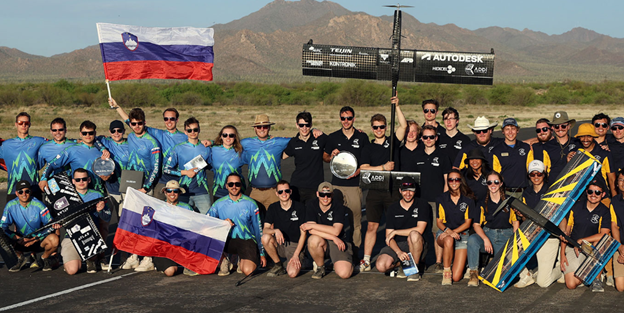
2023- Electronic Warfare
2023’s theme was electronic warfare. The missions were as follows:
Mission 1 – Standard Flight Course
3 laps in 5 minutes
Mission 2 – Electronics Package Payload
As many laps as possible in 10 minutes with a payload of no less than 30% of total aircraft weight
Mission 3 – Jamming Antenna
3 laps as fast as possible with a PVC pipe mounted to one wingtip (counterweight allowed)
Ground Mission – Weight Load
Plane is loaded at center to a declared weight – highest load/aircraft weight ratio wins
2022- Humanitarian Mission
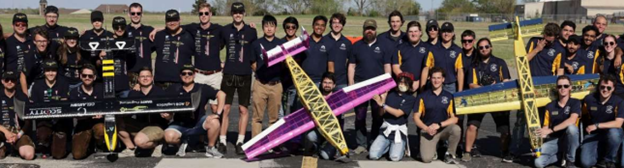
2022’s competition simulated humanitarian efforts. The missions were:
Mission 1 – Deployment Flight
3 laps in 5 minutes
Mission 2 – Staging Flight
3 laps in 5 minutes carrying a minimum of 10 syringes
Mission 3 – Vaccine Delivery
As many laps as possible in 10 minutes, dropping one payload package remotely after each lap
Ground Mission – Weight Load
Plane is loaded at center to a declared weight – highest load/aircraft weight ratio wins
2021- UAV with Sensor Suite
2021’s objective was to create a UAV with a towed sensor. No official photos are available, as this competition was held virtually. The mission requirements were as follows:
Mission 1 – Standard Flight Course
3 laps in 5 minutes
Mission 2 – Delivery Flight
3 laps in 5 minutes carrying payload
Mission 3 – Sensor Flight
As many laps as possible in 10 minutes, deploying sensor remotely after each 360-degree turn
Ground Mission – Weight Load
Plane is loaded at center to a declared weight AND demonstrate that the sensor incurs no damage after being dropped in the shipping container
References
[1] AIAA Design/Build/Fly Competition Rules 2023. [Online]. Available: https://www.aiaa.org/docs/default-source/uploadedfiles/aiaadbf/resources/dbf-rules-2023-final.pdf

 Jordan's Juide